Mezinárodní tým paleobiologů s českou účastí zkoumal zbytky ca 327 mil. let (spodní karbon, serpukhov) starých nálezů coleoidních hlavonožců z Montany.

Článek publikovaný v Nature Communications se zabývá hlavonožci, kteří mají unikátně zachovalé zbytky schránek i měkkých tkání. Na základě analýzy klíčových znaků byla přehodnocena fylogeneze dvoužábrých hlavonožců a potvrzena fylogenetická hypotéza (podpořená také molekulárními daty) o čase divergence osmi a deseti ramenných hlavonožců v intervalu mezi středním permem (ca 275 mil. tet) a spodním triasem (ca 250 mil. let). Zkoumané zbytky z karbonu USA představují evoluční experimenty raných coleoidů s řadou variabilních znaků, které se objevují v řadě fylogenetických linií pozdějších taxonů. Článek poukazuje na unikátní tafonomii, ale také neúplnost fosilního záznamu a limitované zachování jak původně měkkých, tak i pevných částí (např. omezené přetrvání biominerálu aragonitu v čase). Mezinárodní tým vedl prof. Christian Klug z Univerzity v Zurichu, českou paleontologii zastupoval prof. Martin Košťák, PřF UK.
Zdroj: Přírodovědci.cz
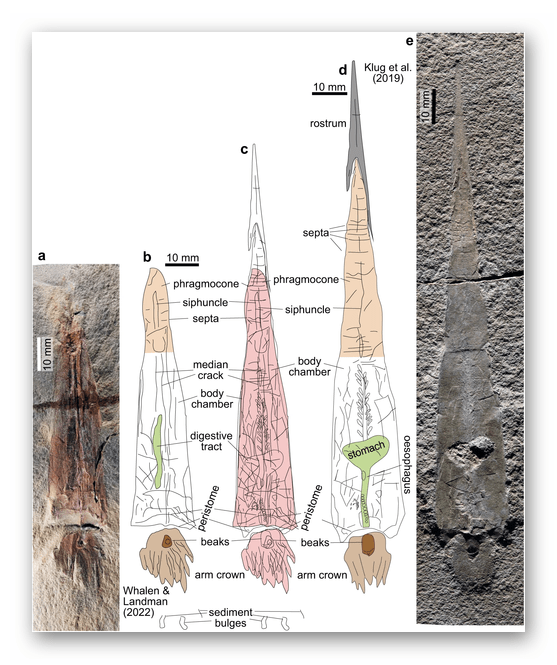
Recently, on the basis of a single specimen (ROMIP 64897) from the Royal Ontario Museum (Canada), Whalen and Landman1 described the new coleoid taxon with a fairly completely preserved frontal part as Syllipsimopodi bideni. The specimen, recovered from the Bear Gulch Limestone, Heath Formation in Fergus County, Montana, USA, is of Serpukhovian age2. Based on the suggested presence of a gladius, ten arms, and fins, as well as the supposed absence of a phragmocone, the authors interpreted the “remarkably well-preserved” specimen as “the oldest definitive vampyropod and crown coleoid”1. We herein test if the fidelity of preserved characters in S. bideni affects the interpretation of this organism—particularly by comparing these characters to other soft bodied cephalopod fossils from Bear Gulch. We provide evidence for the likely synonymy of S. bideni and Gordoniconus beargulchensis. Our interpretation casts doubt on the phylogeny proposed by Whalen and Landman1, who suggested S. bideni as the oldest vamyropod. Vampyropoda ( = Octobrachia or Octopodiformes) is considered to be the sister group of all ten-armed cephalopods (Decabrachia)3,4,5, which is also supported by recent molecular analyses6,7,8.

 Podcast & blog by Pepik Hipik & Knižní kočka